
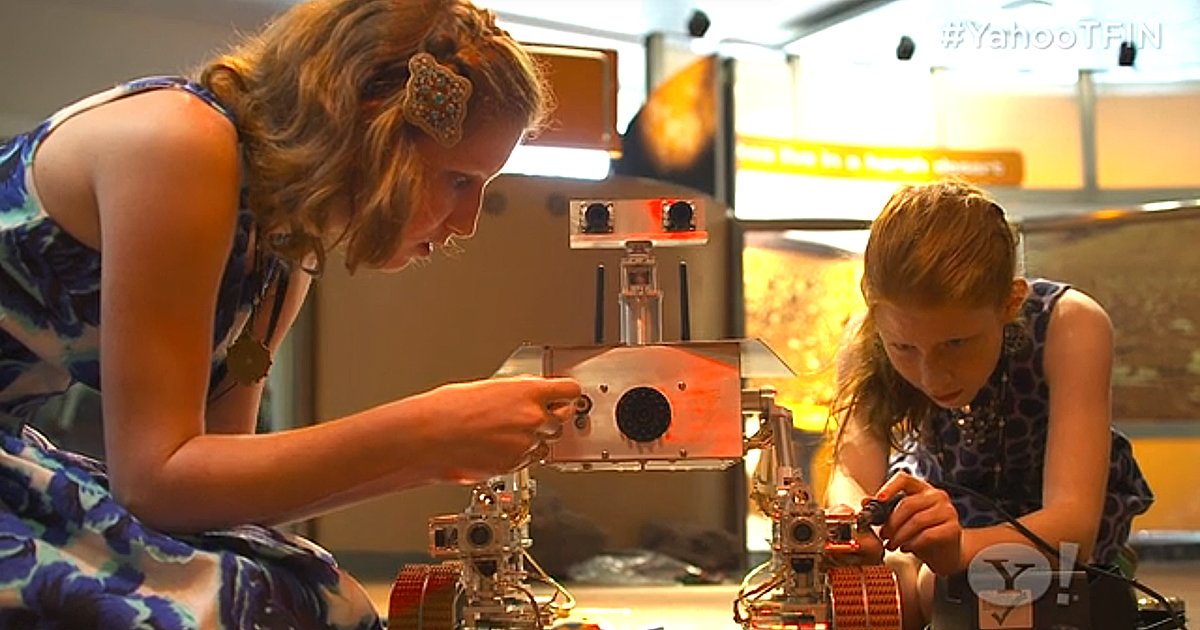
Photo by Andrew Terranova.
Two Sisters (and Their Dad) Build Real Robots
By David Sanger
When we decided to make August ROBOT MONTH at the Stan Winston School of Character Arts, we found ourselves searching the web for cool robot art to post. One of those searches turned up an article about a couple of young girls who made a scale replica of the Spirit Mars Rover as a display for the New York Hall of Science. Machinist, Camille Beatty (13) and her sister, circuit board electronics specialist, Genevieve Beatty (11)--encouraged and prompted by their father, Robert Beatty--build multi-functional remote-controlled robots that light up, move, and inspire! As soon as we saw their amazing website we knew we had to feature these roboticists. The girls were kind enough to take time from their busy robot-making schedule to answer a few questions for us.
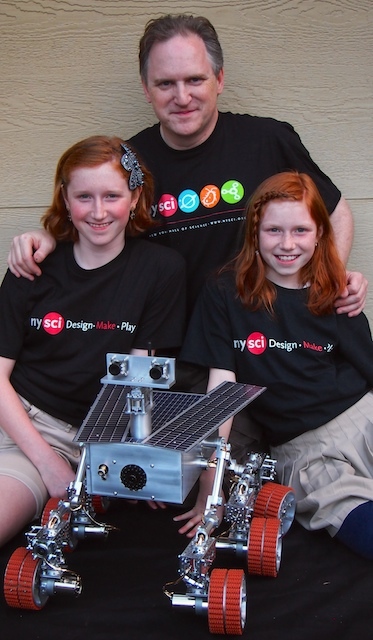 (Robert Beatty with his two daughters, Camille and Genevieve, and the Spirit Mars Rover scale replica – a family that builds robots together as Beatty Robotics!)
Jump To Section
- Meet Camille and Genevieve Beatty
- Building Robots and Finding Inspiration in NASA’s Mars Exploration Rovers
- Tools and Materials
- Dream Projects for the Beatty Sisters
- Advice to Fellow Robot Enthusiasts
Meet Camille and Genevieve Beatty
SWSCA: How did you first get interested in making robots?
Camille: Two years ago, when I was 11, I started taking things apart around the house. Remote controls, clocks, anything I could find. I wanted to see what was inside. I saw tiny little wires, and resistors, and circuit boards, and I thought it was amazing. My Dad said, "Instead of taking things apart, do you want to try to build something?" I got super excited. We didn't know anything, so we started doing really small experiments with LEDs, switches, breadboards, and stuff like that.
SWSCA: What was your first robot, and what did it do?
Camille: After doing projects with breadboards [a solderless base for prototyping electronics] and LEDs [light-emitting diodes], my dad said, "What do you want to build next?" I said, "I want to build a robot!" My little sister, who was 9, joined in too. She wanted to build a droid from Star Wars: The Clone Wars, her favorite show, so we made that our goal. My sister, Dad, and I didn't know anything about electronics, soldering, machining, microcontrollers, or anything like that, but we started the project and learned together using the Internet. Our first little robot, which we called "I.C. 12," had these cool eyes that we hacked out of some LED lamps.
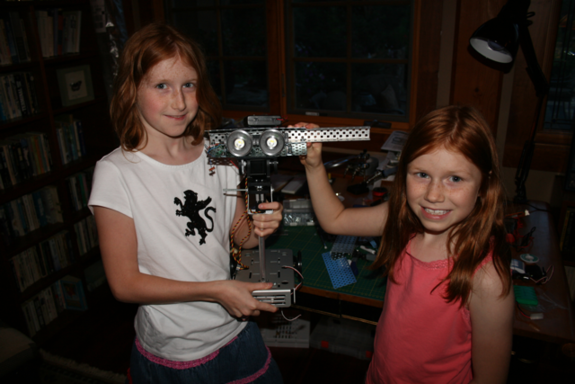 (I.C. 12 – the first little robot built by the Beatty sisters.)
Building Robots and Finding Inspiration in NASA’s Mars Exploration Rovers
Camille: It had three wheels, little servos for motors, and we configured an IR app to control the robot with our iPhone. But the best part was that we made some metal trays and screwed them to the side of the robot so that my sister had a little vehicle to transport all her Playmobil figures that she loved playing with. After we built our first little droid, we wanted to build another robot, and then another...we were hooked. We built robots that rolled, robots that crawled, and robots that flew. It was really fun.
SWSCA: Do you have a favorite robot?
Genevieve: My favorite robot is the Spirit Mars Rover. We saw a movie about Spirit and Opportunity. That's when we decided we wanted to build one ourselves.
Camille: My favorite real-life robot is the Spirit Mars Rover. It's amazing. But in our workshop, my favorite robot is our 8-wheeled Russian Lunar Rover called Lunokhod, which we built for a space museum in Prague.
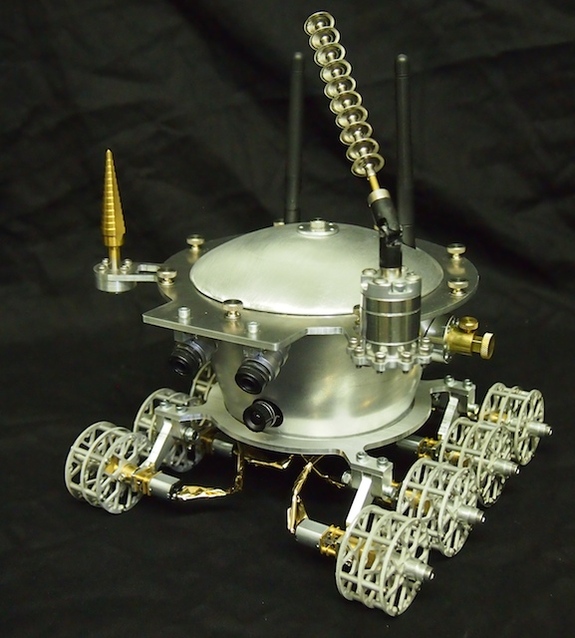 (Lunokhod, an 8-wheeled Russian Lunar Rover built by the Beatty sisters.)
Tools and Materials
SWSCA: Where do you get your materials?
Camille: We build almost all our robots out of aluminum parts that we machine ourselves, hack from other items, or purchase as component parts. We love machining and we love metal. Our suppliers include McMaster-Carr, Servocity, AndyMark, and others.
Genevieve: We build our robots with Arduino microcontrollers. We buy our electronic parts from all sorts of different robot websites, including Sparkfun Electronics, Robotshop.com, eBay, and places like that.
SWSCA: What are your favorite tools?
Camille: I'm the machinist in our family. That's one of my specialties. My Dad and I didn't know how to machine metal when we started. But once we learned how to do it, I've taken it over and I do all the machining. My favorite tool is our CNC Mill, which we made ourselves so that we could cut metal more accurately. But I really love using our manual mini mill and our mini drill press.
Genevieve: I love soldering. I do all the soldering on our robots. I love soldering circuit boards, through-hole soldering, soldering wires, switches, and all kinds of soldering. My favorite tool is our Weller soldering station. It's awesome!
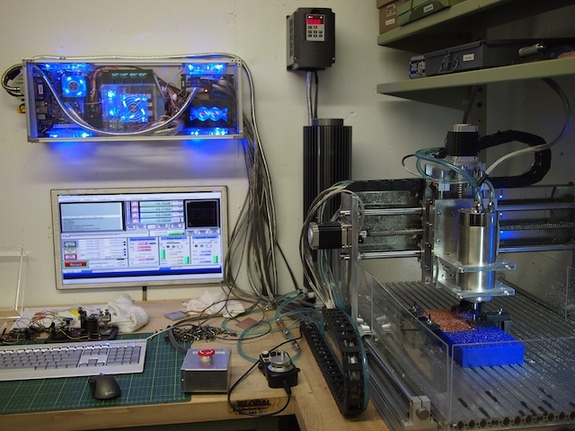 (The Beatty Robotics home workshop 3-axis CNC mill, made to shape metal more accurately than they could with the manual mill.)
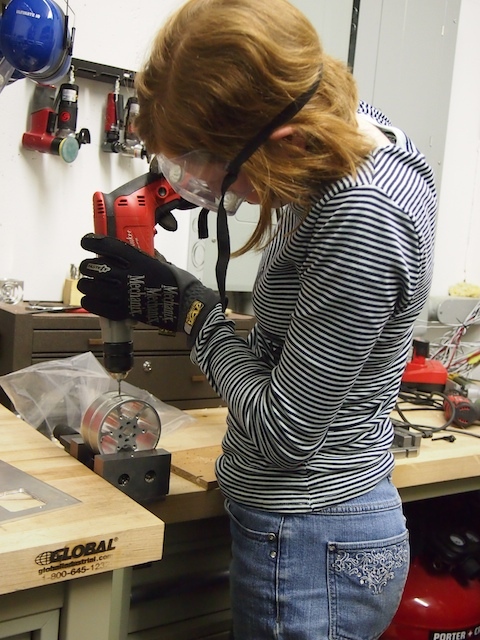 (Camille taps 6-32 threads for the wheels of the Mars Rover.)
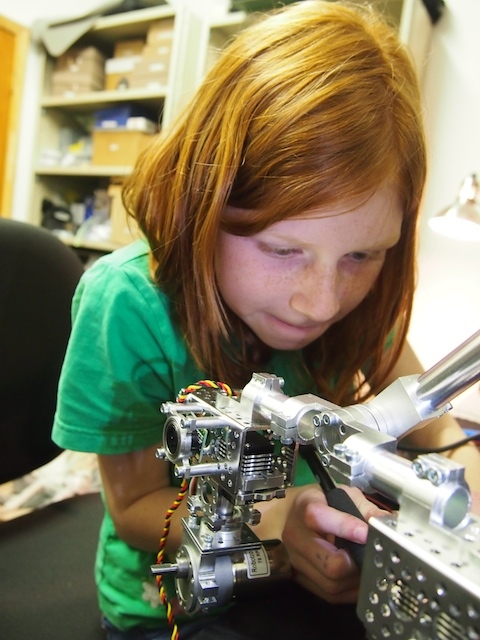 (Genevieve solders wires for the electronics on the chassis.)
Dream Projects for the Beatty Sisters
SWSCA: What is your dream project?
Camille: Actually, the Mars Rover robot we built for the New York Hall of Science was a dream project for us. We're super excited that we finished it and that it's now operating in the exhibit. Some day, it would be cool to make a similar Mars Rover replica for a NASA museum, something that kids could operate to see how the real Mars Rover works when they visit a NASA location. My other dream project is a project that I've been working on for a long time, which is our "Snailbot." I love nature and bringing things together. We're building a robot snail with all the electronics inside the shell of the robot. The antennas of the snail will actually be sonars so that the snail can roam around the house autonomously, and of course, there will be an Xbee radio inside the snail for remote control. It's really cool.
Genevieve: I love art. I love drawing. I would love to think up really crazy droid-like robots, sketch them out, and then build them.
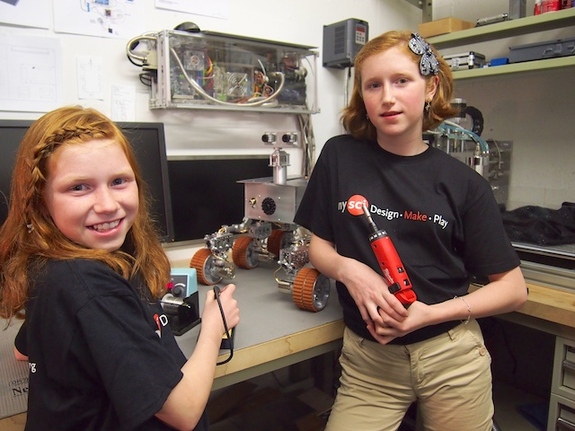 (Camille and Genevieve in the Beatty Robotics workshop with their scale replica of the Spirit Mars Rover commissioned by the New York Hall of Science.)
Advice to Fellow Robot Enthusiasts
SWSCA: What advice would you give to someone wanting to learn robotics?
Camille: Start building. It's fun. Use the Internet to learn. You can learn everything from Google and YouTube. But sometimes it's hard, and you have to be persistent. If something doesn't work, you just have to keep trying.
Robert (Dad): I have some advice for parents. Parents may want to look at starting with an Arduino kit, such as the Sparkfun Inventor's Kit, and then go from there. I have found that the key to engaging my kids in these sorts of projects is to have them do the work with their own hands. I buy the parts and materials, and I keep the project moving forward, but the kids do all the work: soldering, machining, wiring the components together, etc. The minute I start doing the work myself (because I like robotics, too!), they lose interest. They get distracted. I have found that they don't want to WATCH. That's boring. Their minds drift. They want to DO IT. That's what keeps them engaged and gives them a sense of creation, of making something. So, the challenge as a parent is to have the patience to be the one watching and guide them through the process, but not grab the tool and do it yourself.
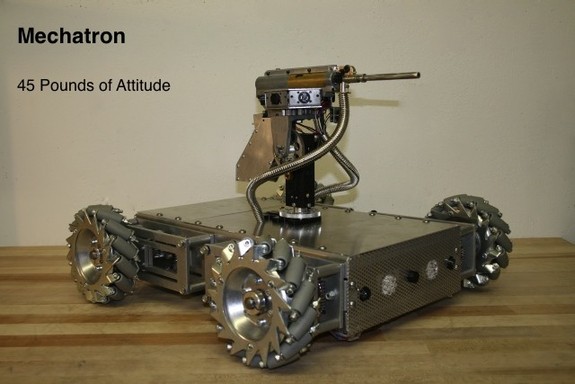
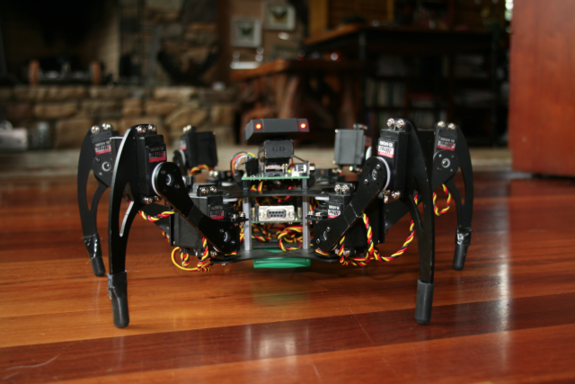
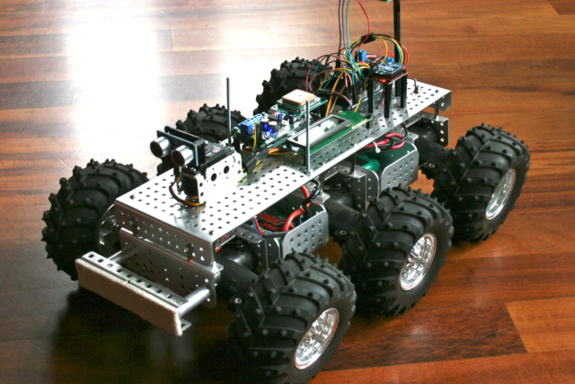
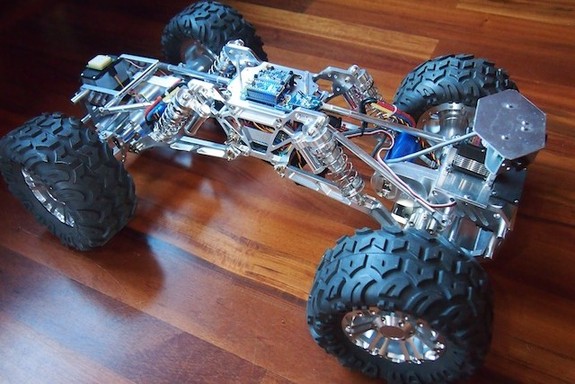 (Mechatron, Creepy Crawler, Trekker, and Terrabot – just some of the many robots designed and built by Beatty Robotics.)
Click the Video Player above for a video interview from Explainer TV.
Top Photo Credit: Andrew Terranova. All other photos courtesy Beatty Robotics.