

The Making of The Island of Dr. Moreau (1996)
Among Stan Winston’s favorite movies as a child was 1933’s Island of Lost Souls, based on H.G. Wells’ novel about a deranged scientist — played by Charles Laughton — who genetically engineers half-human, half-animal mutants. The story was remade as The Island of Dr. Moreau in 1977, in a modestly successful film starring Burt Lancaster and Michael York. In the late 1990s, British writer and director Richard Stanley attempted yet another cinematic take on the story, having written a much-admired script and secured the acting services of Marlon Brando as Dr. Moreau.
Jump To Section
- Preparing 42 Characters for The Island of Dr. Moreau
- Shooting Challenges on the Richard Stanley Film
- Hiring John Frankenheimer as Director
- Adding More Beast-people
- Script Changes in The Island of Dr. Moreau
- Richard Stanley Makes an Appearance
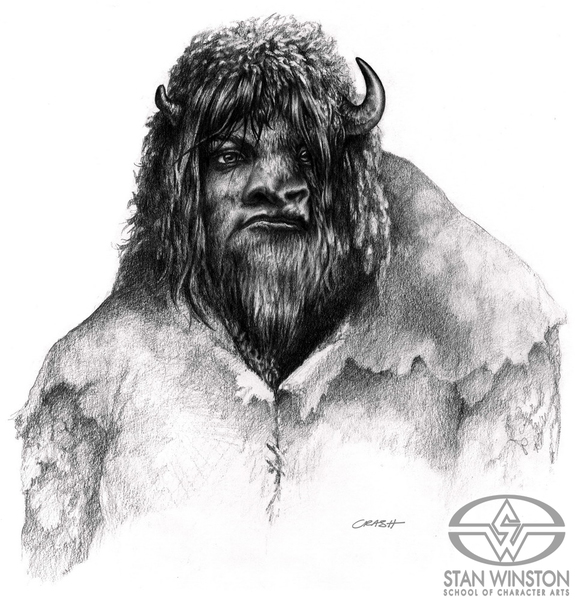 (Mark Crash McCreery’s drawing of the Bison-man.)
 (The Bison-man (David Hudson), as he appeared in the film.)
Preparing 42 Characters for The Island of Dr. Moreau
Originally, Stan Winston Studio was brought on to design and build forty-two ‘beast people’ for this latest The Island of Dr. Moreau (1996), fourteen of which would be hero characters realized as complex prosthetic makeups applied to performers. The remaining background characters would sport one-piece masks. The all-makeup approach was mandated by a short design and build schedule — only twenty weeks from start to finish, due to a rushed start of principal photography — and also reflected Stans’s disenchantment with creating characters using all mechanical heads.
 (Alan Scott touches up the Hyena-Swine makeup, a combination of prosthetics and animatronics.)
“I wanted to create the man-beasts primarily as prosthetic makeups so that I could take the performance out of the puppeteer’s hands and put it back under the control of the performers in the makeups. This was the perfect project to do that because these characters were essentially humanoid."
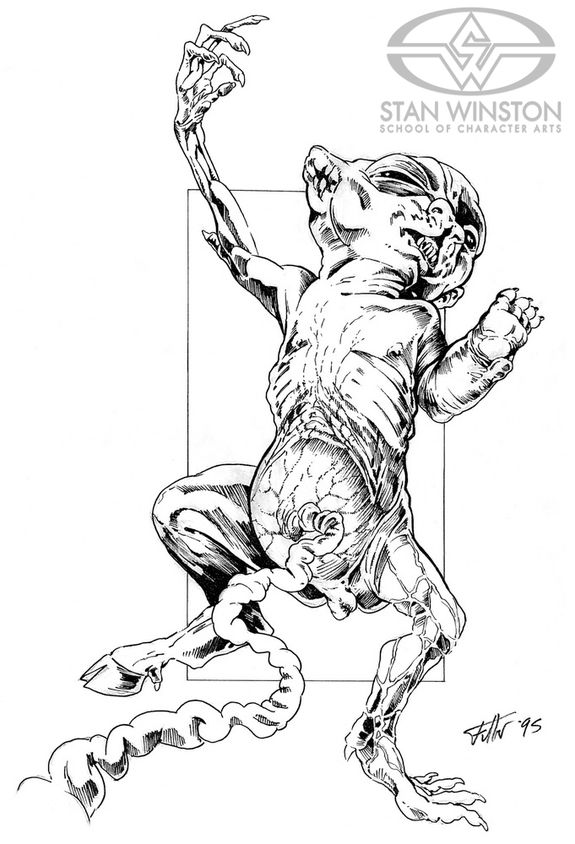 (Concept artwork for the mutant baby by Bruce Spaulding Fuller.)
Stan’s team would incorporate some animatronics for characters requiring elongated, articulated muzzles, blending those radio-controlled features with the makeup appliances. “We developed this partially prosthetic, partially animatronic face, which gave us the best of both worlds.”
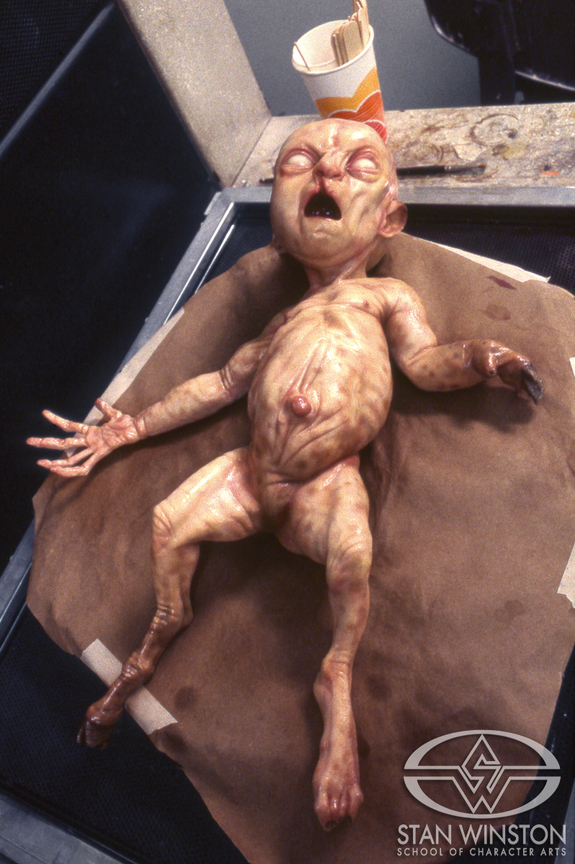 (Joey Orosco’s mutant baby character.)
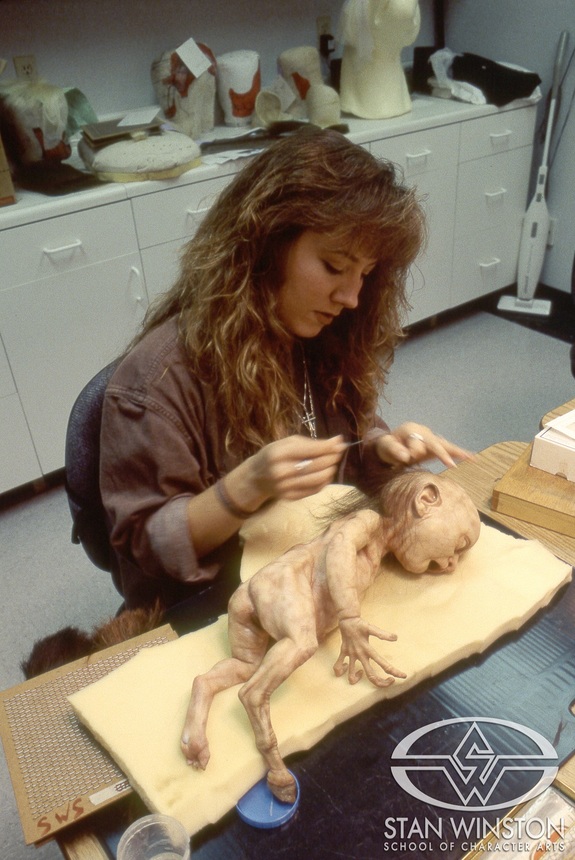 (Ursula Ward punches hair into the mutant baby at Stan Winston Studio.)
 (The internal mechanical structure of the mutant baby.)
Shooting Challenges on the Richard Stanley Film
Despite the short schedule, all of the requisite silicone makeups and masks had been built and shipped by the time Shane Mahan and a crew of makeup artists left for Australia, where the film was being shot. “There hadn’t been any time to test these makeups,” Shane Mahan said, “which made me a little nervous. I was also worried about the fact that I was only going to have fourteen makeup artists on the production with me, which was a small crew to take care of forty-two characters. But, even with all of that, I left for Australia feeling good about the characters we’d created and the upcoming shoot.”
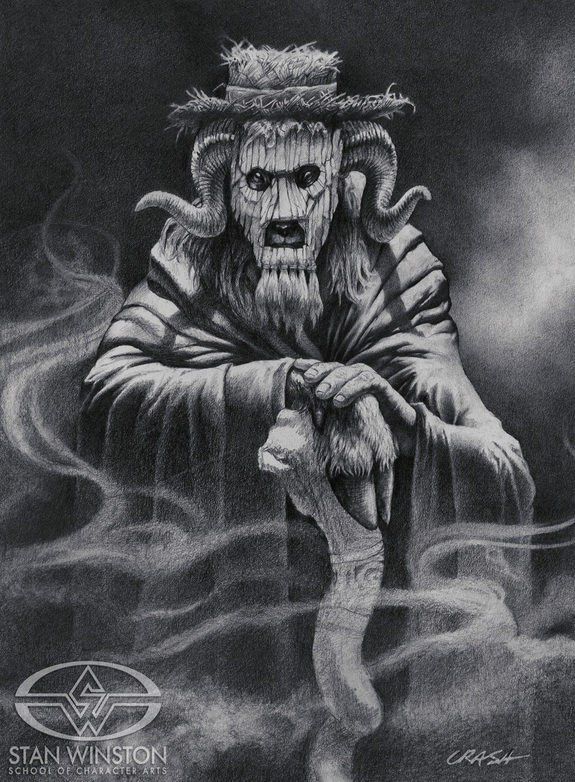 (“Sayer of the Law” concept art by Mark Crash McCreery.)
That feeling wouldn’t last long. In fact, trouble started the very day Shane arrived in Australia. “After a twenty-hour flight, I got there, only to hear that Richard Stanley, the director, had been fired that day. They’d only been shooting for two weeks, but Richard had run into problems with some of the actors and the studio, and so he was fired. Their plan was to find another director and start-up shooting again right away.”
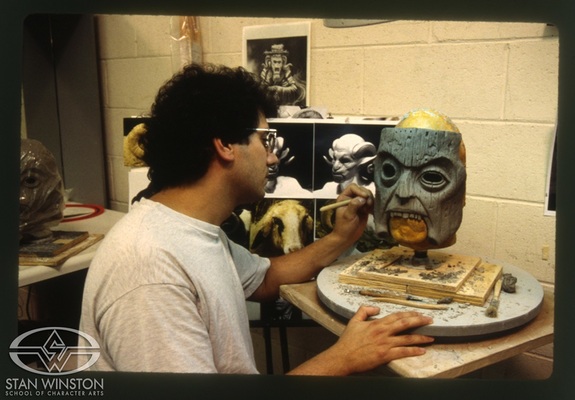 (Bill Basso sculpts the “Sayer of the Law's” ritual mask.)
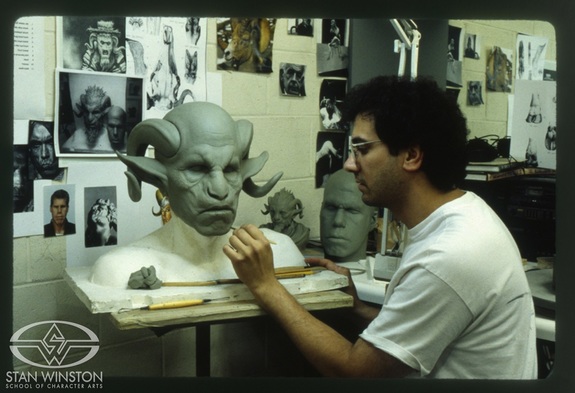 (Bill Basso details the “Sayer of the Law” sculpture at Stan Winston Studio.)
 (Ron Perlman as the “Sayer of the Law” on the set of The Island of Dr. Moreau.)
Hiring John Frankenheimer as Director
Production stalled for three weeks while the studio and producers conducted a search for a new director. “They went through a whole list of possible directors. We’d hear names like Tobe Hooper, Roman Polanski — and I was like: ‘Yes! Get Roman Polanski!’ Finally, we heard they’d hired John Frankenheimer. I thought: ‘John Frankenheimer? The guy who did Manchurian Candidate with Frank Sinatra in the 1960s?’ He was well into his sixties by this time, but he turned out to be a great guy. He took over this movie, fully realizing what he was walking into — which was a film where somebody else had already filmed scenes, had already designed and built sets, had already cast all the roles and had already signed off on the creature designs.”
 (A scene from The Island of Dr. Moreau. Marlon Brando insisted on applying his own makeup, consisting of white face paint, buck teeth, rubber gloves filled with baby powder, and a fruit basket that had been converted into a hat.)
John Frankenheimer also walked into a situation in which many cast members were unhappy. Rob Morrow, from television’s Northern Exposure (1990-1995), was particularly so — and, in fact, he soon quit and was replaced with David Thewlis in the role of Edward Douglas. “Rob Morrow seemed to hate every single second of being there,” Shane Mahan recalled. “Other actors were just out of their minds. They would walk off the set at noon — just get in their cars and drive home. On top of that, there were major script rewrites. From day one, it was complete and utter bedlam.”
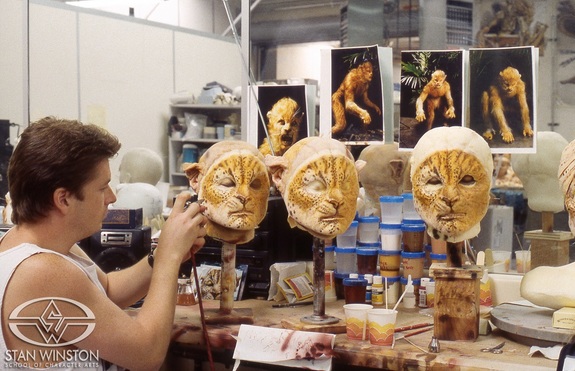 (Mark Maitre paints facial prosthetic appliances for the leopard-man, “Lo-Mai,” played by Mark Dacascos.)
Nonetheless, Shane Mahan kept his cool, a quality for which he is known at the studio. “Of all the people who could have been over there, supervising that show,” Mark 'Crash' McCreery said, “Shane was probably the one best able to handle it. He is the quintessential positive thinker. If the ship is sinking, Shane decides that it’s a good day to go for a swim! So, as usual, he handled everything that went on with Island of Dr. Moreau really well.”
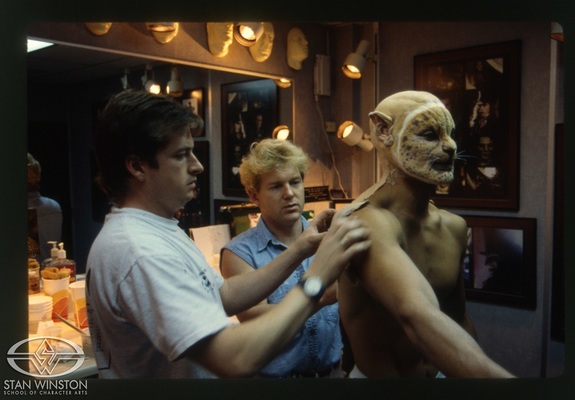 (Mark Maitre and Shane Mahan apply the leopard-man makeup to actor Mark Dacascos.)
Behind-the-scenes of The Island of Dr. MoreauToday is the 25th Anniversary of John Frankenheimer's The Island of Dr. Moreau. So let's celebrate it with a never before posted behind-the-scenes footage from the Stan Winston Studio archive where the team of SWS test the Lo-Mai makeup on the amazing Mark Dacascos.
Posted by Stan Winston School of Character Arts on Monday, August 23, 2021
Video above: The team of SWS test the Lo-Mai makeup (applied by Mark Maitre and Shane Mahan) on actor Mark Dacascos.
Adding More Beast-people
Shane Mahan’s upbeat, positive attitude was tested when John Frankenheimer immediately requested that his Island of Dr. Moreau be populated with 150 beast people rather than the forty-two indicated in Richard Stanley’s original script. The small makeup crew, which would have been stretched to the limit dealing with forty-two characters, now faced an assignment that had nearly quadrupled in size.
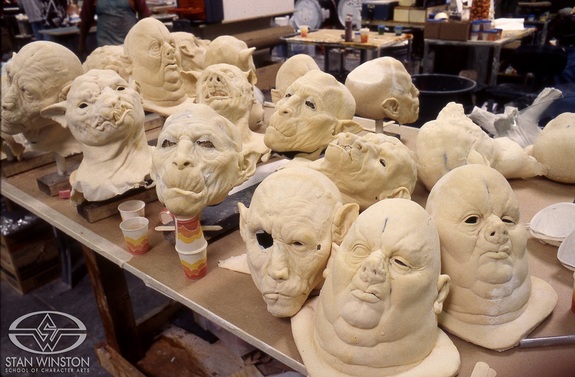 (A menagerie of beast-people masks ready for paint.)
“We had to make all of these additional background masks just to start,” Shane said. “And then, throughout the shoot, we had these fourteen makeup artists trying to deal with makeups and masks for 150 people every day. Because there were so many characters and so few makeup artists, we’d have to get up at three o’clock in the morning to get everybody ready in time; and then, at the end of the day, by the time we’d cleaned everybody up and put everything away, it would be ten o’clock. It was very tough.”
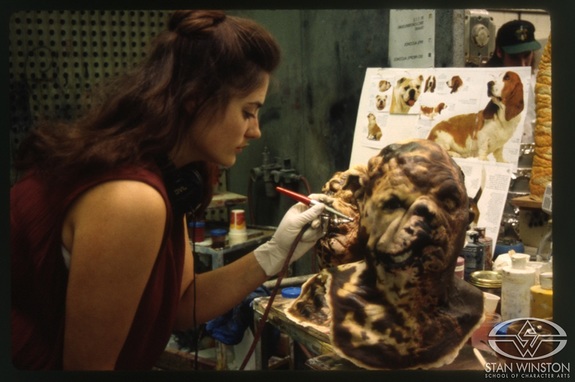 (Beth A. Hathaway airbrushes one of the 150 “beast-people” created by Stan Winston Studio for The Island of Dr. Moreau.)
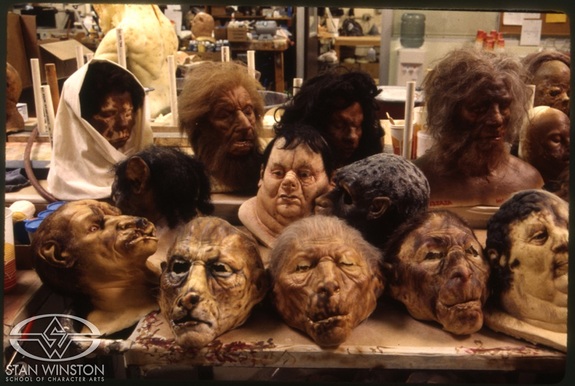 (An assembly of completed “beast-people” masks created by Stan Winston Studio for The Island of Dr. Moreau.)
Script Changes in The Island of Dr. Moreau
Another problem were last-minute script changes that resulted in characters that had been designed for nighttime scenes — such as "Lo-Mai" (Mark Dacascos), the leopard-man — being filmed in broad daylight, or characters who had been designed with one action in mind suddenly being asked to do something entirely different.
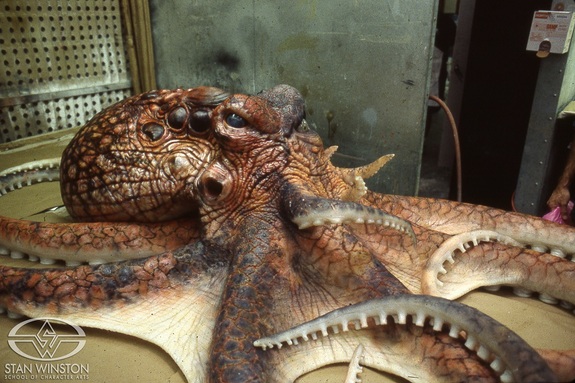 (Mutated octopus puppet created by Stan Winston Studio for The Island of Dr. Moreau.)
For a scene in which a dead beast-woman gives birth to a mutant baby, for example, Joey Orosco had sculpted a non-articulated silicone form. Just prior to shooting the scene, John Frankenheimer decided he wanted the woman to be alive and convulsing throughout. Shane Mahan and his team had only minutes to mechanize the prop, adding rods to joints and installing bladders under the skin, all on the fly. Casting changes, too, complicated the creature effects work.
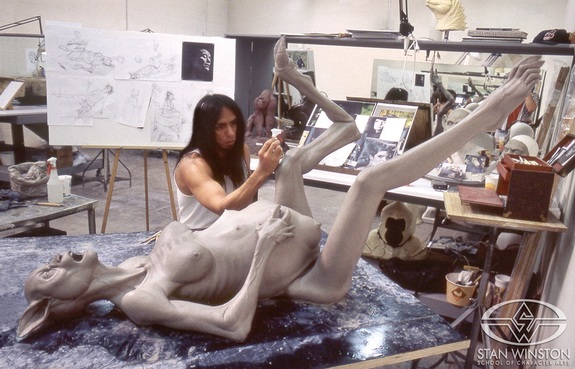 (Joey Orosco at work on the pregnant “beast-woman” sculpture.)
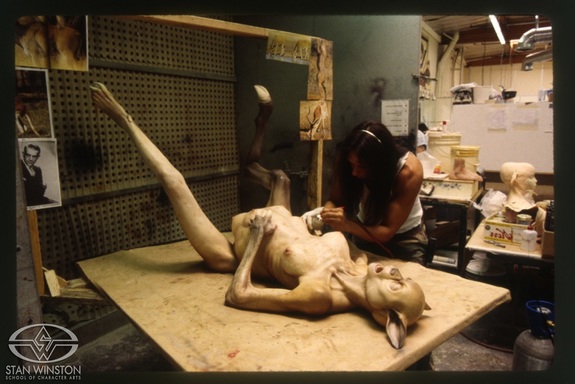 (Joey Orosco airbrushes the beast-woman, which would later be mechanized on the fly for the scene where she gives birth to a mutant baby.)
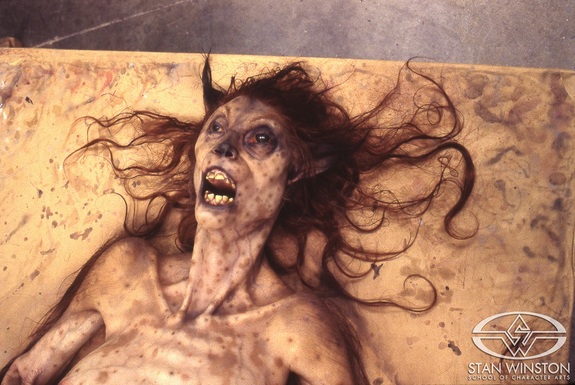 (Head and shoulders of the completed “beast-woman.”)
The studio had designed a baboon character specifically for the Australian actor who had been cast in the role — a very small, wiry man with a thin face. When that actor was mugged in Sydney shortly after the shoot started, suffering a broken leg, John Frankenheimer put behaviorist Peter Elliott into the role. “They didn’t want to deal with casting a new person who looked like the original guy,” Shane Mahan said, “and Peter was there already. So it was just, ‘Let Peter do the baboon guy.’ The problem was that Peter’s physical appearance and his facial structure were nothing like the guy the makeup had been designed for. Rather than wiry, Peter was quite stocky, and he had a broader face. So we had to stretch and kluge our original baboon makeup to try to make it fit him, and it never looked right. That was really disappointing. We had always been such perfectionists — we weren’t in the habit of throwing a makeup together on somebody in that way.”
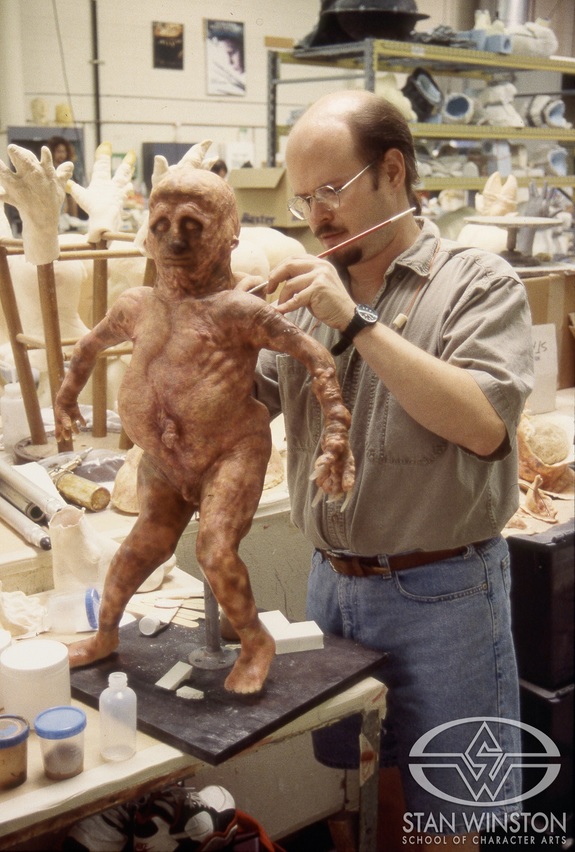 (Bruce Spaulding Fuller works on the Majai full-body prosthetics designed for Nelson de la Rosa, the smallest actor in the world at that time. Because Marlon Brando wanted him to be in many more scenes with Dr. Moreau, Shane Mahan’s team had to produce a more complex and detailed make-up for Majai's character, with the wardrobe department providing matching miniaturized versions of Dr. Moreau's clothes.)
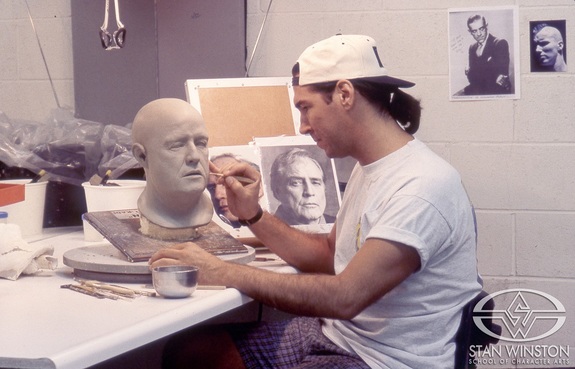 (Mike Smithson details a Marlon Brando likeness sculpture. The scene where Dr. Moreau is killed and burned required a replica of the actor. When Marlon Brando didn't show up for his life-casting session, Shane Mahan called on Dick Smith, who - for The Godfather (1972) - had made a life cast of the actor two decades previous.)
 (The completed Dr. Moreau dummy head.)
Pictured above: The completed Dr. Moreau dummy head.
Richard Stanley Makes an Appearance
There was also some unsanctioned recasting among the background characters. Original director Richard Stanley, understandably upset that he’d been fired from a film he had nursed and developed for years, had been issued a restraining order to keep him a good distance from the production site. Rather than return home to England, however, he had taken up residence with a group of young people living in the surrounding forests, called ‘ferals'. “They were these hippie people, who were living in a little commune in the woods. Most of them were teenagers from Germany, very free spirits, and many of them had been hired to play the background beast people. They were living in the area anyway, and it was a way for them to make a little money — just to show up, put on one of the masks and stand in the background of shots.
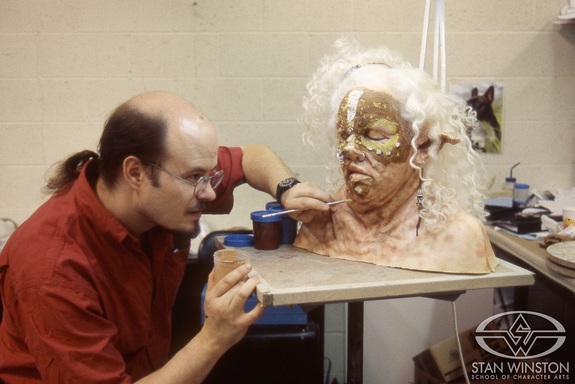 (Bruce Spaulding Fuller works on the Sow-lady makeup at Stan Winston Studio.)
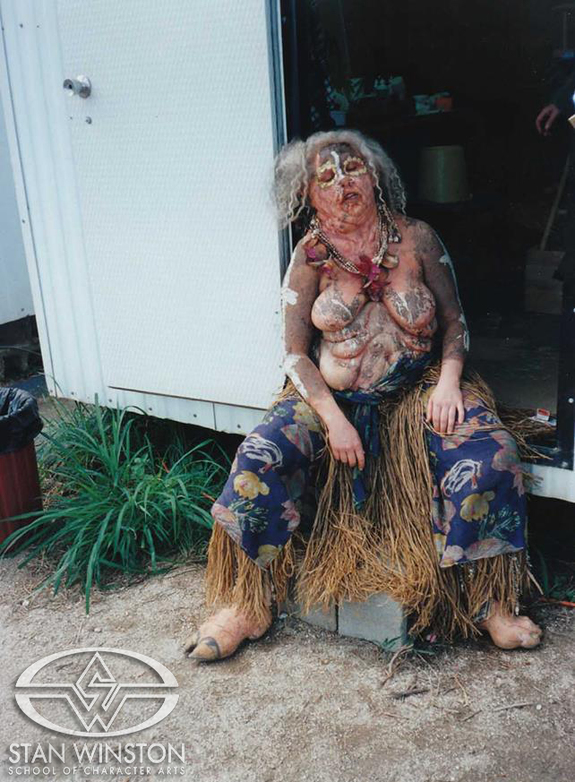 (Actress Fiona Mahl on the set of The Island of Dr. Moreau in the finished Sow-lady makeup.)
When Richard Stanley was fired and ordered off the set, he went to live with them and became their guru. “I learned later that one crazy night around the campfire, the ferals, and Richard had come up with the idea of stealing one of the masks and a piece of the wardrobe so that Richard could wear them as one of the background people. That way, he could stand around on set and observe what was going on without being busted for violating the restraining order. And that’s what he did.” Shane Mahan was not aware of Richard Stanley’s presence on the set at the time, but, in retrospect, he recalled that one of the background performers had behaved rather strangely. “There was this one guy who would never take off his mask. I’d say to him: ‘Do you need some water? Do you want to take that mask off and take a break?’ And he never would. This intense, dark brown eye would just stare at me through the mask.”
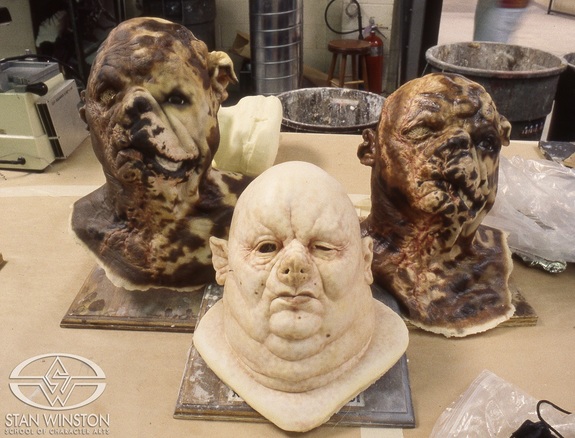 (A trio of finished beast-people masks. One of the dog masks, 'mask 46,' went missing, and later it turned out that Richard Stanley had been secretly visiting the set wearing it.)
With all of the production delays, changes, and problems, Shane Mahan and the rest of the SWS team wound up being in Australia for six months — three months longer than originally scheduled. “It was the most grueling six months imaginable. Still, as tough as it was, I have fond memories of that show. The whole thing was an adventure. I knew, even as it was going on, that I’d never be on a show like that again. Steven Spielberg was never going to sneak onto one of his sets wearing a mask and costume!” “We did a lot of good work for Island of Dr. Moreau,” added Stan Winston, “but it never really came together in terms of how our creations were shot. Frankly, it was a show that I hid from. It was probably the biggest show we’d ever done that I never even showed up on the set for. I just put poor Shane out there and let them tear him apart!”
- By Balázs Földesi with selections from The Winston Effect: The Art and History of Stan Winston Studio by Jody Duncan
Courses with the Creators of The Island of Dr. Moreau
- How To Sculpt A Character Makeup with Bruce Spaulding Fuller
- Character Makeup - Sculpture Breakdown & Molding Part 1 with Bruce Spaulding Fuller
- Special Effects Sequence Design with Shane Mahan
- Facial Hair Application with Lance Anderson
- How to Make an Eye Mech - Design, 3D Print & Assembly with David Covarrubias
- Maquette Painting Techniques with Trevor L. Hensley
- Animatronics Design Basics with Richard Landon
- Cable Mechanism Basics - Tentacles with Richard Landon
- Introduction to Hair Knotting with Michael Ornelaz
- Hybrid Characters: Blending Practical & Digital FX with John Rosengrant
- How to Make a Monster Puppet - Rods & Cables with David Monzingo
- Makeup Blood FX - Blow Your Brains Out with David Monzingo