
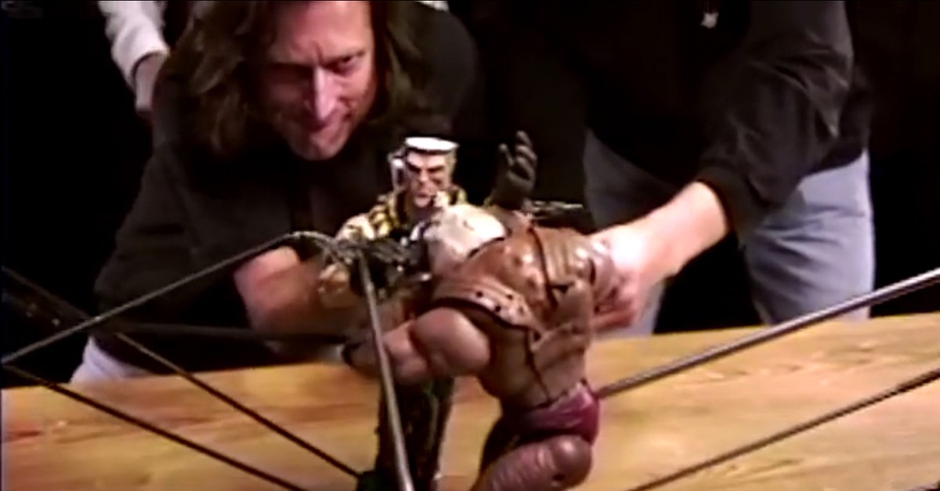
The Making of Small Soldiers’ Toys
For the 1998 film Small Soldiers, Stan Winston Studio began designing the toy characters on paper and in sculptures a mere five months prior to the start of filming. Due to a deal with Hasbro to mass-produce a Small Soldiers toy line, and the necessity for the film’s release to be timed precisely with the debut of that toy line, every aspect of the production was subjected to a similarly tight schedule. The making of the film was such a seat-of-the-pants affair that Joe Dante would later call Small Soldiers ‘the first improv big-budget effects picture.’
Jump To Section
- Designing Characters for Small Soldiers
- Following a Small Soldier Character From Design to Performance
- Puppeteering From Shop to Set
- Making the Process Fun
- Creating a Small Soldiers Toy Line for Hasbro
 (Mark Jurinko paints Link Static, a commando character from Small Soldiers.)
Designing Characters for Small Soldiers
For their design, Winston set up a kind of creative free-for-all within the studio, letting key artists loose to draw as many designs as they cared to. The project gave newer designers, in particular, an opportunity to shine. “Being a new designer at Stan Winston Studio was tough at first,” commented Jim Charmatz, one of those newer artists who got his first shot to design a character for Small Soldiers. “Because Mark "Crash" McCreery was so well established here, it was hard to make your mark as a new designer. But on this show, there was such a tremendous amount of stuff to be designed that a lot of us got a chance to work on it. I was one of about seven people who started right in designing Gorgonites and Commandos.”
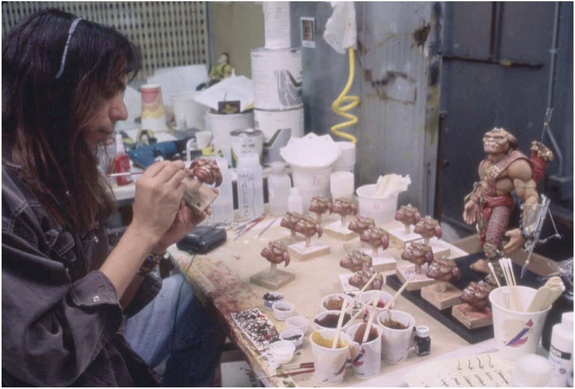 (Joey Orosco matches one of many ‘Archer’ heads to the paint-master.)
Following a Small Soldier Character From Design to Performance
After the artists had generated literally hundreds of drawings, Winston narrowed the designs down to those he liked best. Concepts were narrowed further with Joe Dante, Hasbro, and executive producer Steven Spielberg. Once an artist’s design had been chosen and approved, the designer was allowed to follow that character through, doing the final sculpting, painting, and then on-set puppeteering. John Rosengrant — who had sculpted miniature military figures as a hobby since his teen years — took personal responsibility for two of the leading Commandos, Chip and Kip. “I had a blast designing and sculpting and painting those characters. And, overall, I think my experience with military miniatures really helped us on this show.”
 (John Rosengrant details the Kip Killigan paint master for Small Soldiers.)
Similarly, Jim Charmatz was allowed to follow his Slam-Fist character — a design he’d sketched in only ten minutes, as an afterthought — all the way through to the end. “I got to design it, sculpt it, help make it work mechanically, design the paint job on the computer, then paint it and actually puppeteer it on the set. That was a great opportunity.”
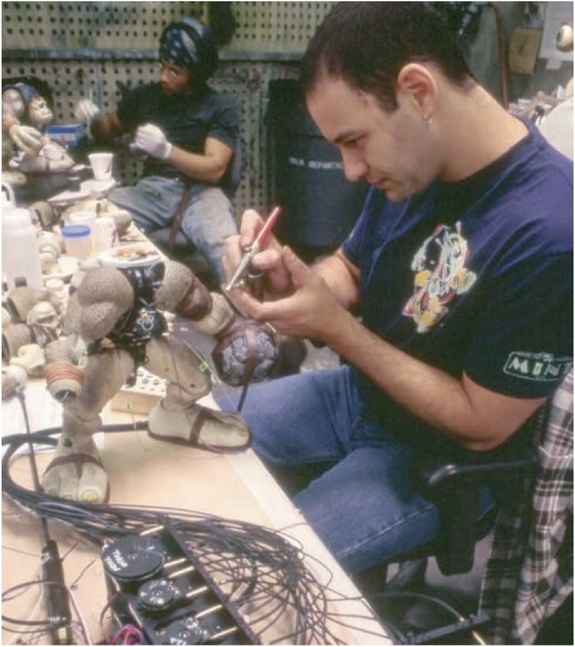 (Jim Charmatz paints his animatronic character, Slam-Fist, as Charles Ratteray assists.)
Puppeteering From Shop to Set
The puppeteers’ status as real actors on the set extended to their providing temporary voices for their characters, speaking the lines of dialogue and vocalizing necessary grunts and howls. “Having us do the voices while they were shooting gave the actors real personalities to act against,” said Rosengrant. “I personally did the voices of Link Static and Slam-Fist. And a few of my on-set sounds actually made it into the final movie. Other than that, my dialogue was replaced with real voice actors.”
 (Ian Stevenson paints his Punch-It character.)
Making the Process Fun
The film's director, Joe Dante, speaking of Stan Winston, said, “When you get into the world Stan’s in, you find it generally populated by movie fans — guys who really loved these pictures when they were kids and always wanted to build monsters and play monsters and get into the world of special effects. Stan is no exception. I met him right after he directed Pumpkinhead, which was a pretty cool little movie. But I didn’t actually get to work with him until Small Soldiers, and by then, he had created this empire. We’d make a pilgrimage over to his studio a couple of times a week to watch their progress. It was very time-consuming and labor-intensive to design so many characters and create them in a way that made them look alive. It was intense, but Stan made it fun.”
 (A partially disassembled Archer puppet.)
Creating a Small Soldiers Toy Line for Hasbro
Winston learned a lot about the toy business through his close association with Hasbro throughout the making of the film. “We found out what it really takes to make a great toy, to make it stand out on the shelf. We learned how the joints of toys worked and all the mechanics that go into them. The whole thing was an education; and we helped to create a toy line that was extremely successful for Hasbro. In fact, ultimately, sales for the Small Soldiers toys out-performed the movie.”
-Jody Duncan
Excerpted from THE WINSTON EFFECT: THE ART & HISTORY OF STAN WINSTON STUDIO
Courses with the Creators of Small Soldiers
- Hybrid Characters: Blending Practical & Digital FX with John Rosengrant
- Hybrid Character Design: Practical To Digital with Christopher Swift
- How To Make An Eye Mechanism - Design, 3D Printing & Assembly with David Covarrubias
- Animatronic Control Systems - Arduino Programming Basics Part 1 with David Covarrubias
- Creature Screenwriting: How To Write Memorable Monsters with Juliet Snowden & Stiles White
- How To Make A Monster Puppet - Rods & Cables with David Monzingo
- Makeup Blood FX - Blow Your Brains Out with David Monzingo
To create your own toys, check out these courses: