
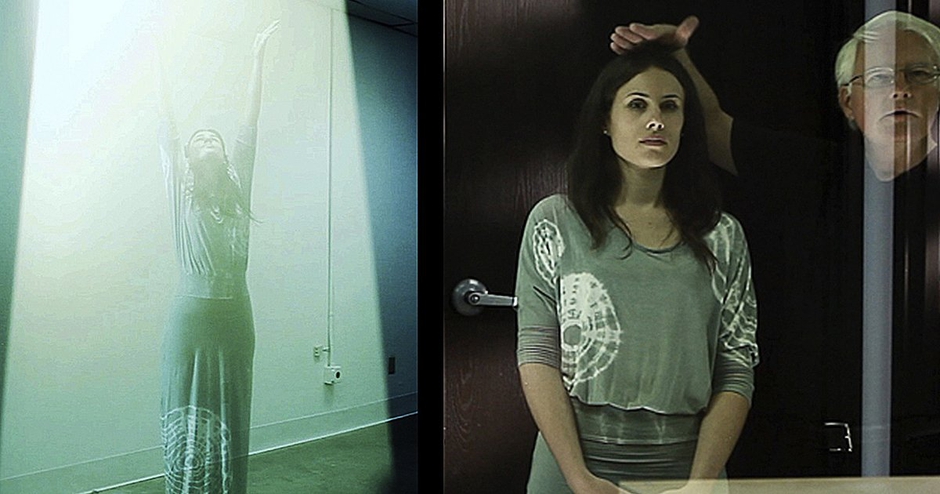
Using Mirrors to Create Illusions in Filmmaking With Mark Sawicki
by Jeff Dixon
To watch the FREE lesson preview, simply click on the player above. Check out the Full Lesson page HERE.
If you’re a fan of special effects at all (and my guess is that if you’re reading this blog, you are), you will truly appreciate this week’s lesson. MIRROR MAGIC - VISUAL EFFECTS USING REFLECTIONS is a unique and specialized look at the use of mirrors in trick photography. The methods presented here are steeped in history and have been used on stage and screen alike for ages. These are techniques that I feel haven’t really been presented before like this in a basic how-to lesson, and who better to lead this journey than VFX veteran Mark Sawicki.
Jump To Section
- A History Lesson in Visual Effects
- The Importance of Lighting and Directing for Mirror Effects
- The Schüfftan's 4th Dimension Technique
- The Pepper's Ghost Effect
- The Schüfftan Box
- The Schüfftan Beam of Light
 (Mark Sawicki's lesson on in-camera visual effects using mirrors.)
A History Lesson in Visual Effects
As with anything, to best understand something, it’s best to know where it came from. So, to begin, Mark takes you through a brief history lesson on trick photography using mirrors. He discusses the pioneer processes, such as the Dircksian Phantasmagoria and the Pepper’s Ghost techniques. These were mainly used on stage to trick audiences into seeing things that weren’t actually there. In fact, these are the same types of techniques that magicians use on stage still today, just in a much grander way.
 (The man, Eugene Shüfftan, with camera at the ready.)
Continuing on, he talks about how these techniques eventually translated to film. Citing movies such as Metropolis, The 39 Steps, and even Darby O'Gill and the Little People, Mark explains all about the Schufftan Process, a way of using a mirror to project miniatures along with the actors simultaneously. The great thing is that all of these historical techniques he discusses are recreated here in this lesson.
 (Darby O'Gill and the Little People employs a mirror and 2 live-action simultaneous scenes TOGETHER in-camera.)
The Importance of Lighting and Directing for Mirror Effects
Before he starts any technique, he gives lessons on how to light for a mirror effect scene, how to dress a set for a mirror effect scene (paying specific attention to the fact that things are reversed in a mirror), and even how to direct actors for a mirror effect scene. It’s this latter part that some of the potential directors out there might be interested in. Mark is a character in himself, and the way he works with his actresses is light and fun.
 (Mark demonstrates the use of a cucoloris to break up a hard light into patterns and shadows.)
The Schüfftan's 4th Dimension Technique
First up is the Schüfftan 4th Dimension technique. Here, Mark places a straight front surface mirror at an angle to block out a section. When you look through the camera, it looks like a continuous wall. He then has actors behind the blocked-out mirror “pull” an actress into the “netherworld.” It’s essentially a split screen technique that still works great, and better yet, it’s all done in-camera.
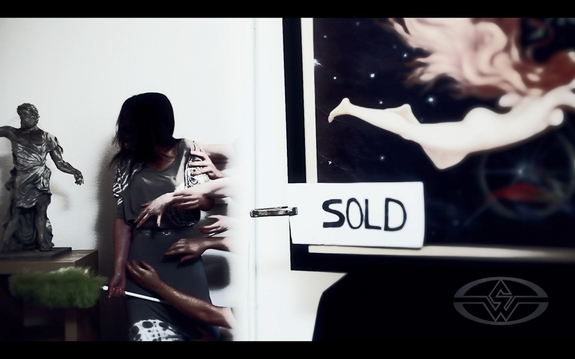 (The final 4th Dimension effect where eerie hands grab at our hero from a void in space.)
The Pepper's Ghost Effect
Secondly, Mark recreates the Pepper’s Ghost effect. This is my personal favorite of the bunch because, honestly, it just works so well you’d be hard-pressed to say it’s not a digitally processed post-effect. Here, he uses a 50/50 Stereoscopic mirror to essentially shoot two things at once. The camera catches the actress through the glass as well as the actress being reflected on it. The combination creates an ethereal effect on the actress playing the “ghost,” and it really packs a punch.
 (Melissa is standing across the room from Mark and Camille. The mirror into the lens places them together and makes SOMEONE an apparition.)
The Schüfftan Box
Next up, Mark builds and recreates a variation of the Schüfftan box. This is the exact same technique that was used in many of those aforementioned films. This is a technique that uses a matte and a counter-matte, which basically is the foundation of all compositing in special effects. In this example, by using this process, Mark can make one actress look extremely large while the other is normal-sized. Combined, they work flawlessly, and you can see how many of these types of effects in film are still used today.
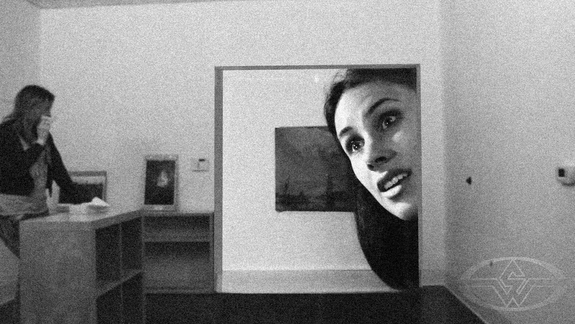 (A matte box with a mini gallery wall set into a mirror creates an Alice in Wonderland effect.)
The Schüfftan Beam of Light
And lastly, Mark uses a mirror to create light effects. Specifically for this one, he creates a beam of light across an actress that, in reality, doesn’t exist there. Again, it’s all done simply with a mirror. Really basic and yet very effective.
 (Can't guess how THIS is done? Well... MIRRORS. And light. And a girl. And a camera.)
All in all, this is a lesson that is both extremely simple and yet utterly effective. The charm here is that, honestly, anyone can do it. All you need is a mirror and a camera. And I promise, after watching, you’ll want to bust out your own camera and try the techniques yourself. Enjoy.
--Jeff Dixon
Check out the Full Lesson page HERE: Mirror Magic - Creating Visual Effects Using Reflection
- Find out about MARK SAWICKI HERE.
- WATCH Mark Sawicki's tutorial on STOP-MOTION ANIMATION.