
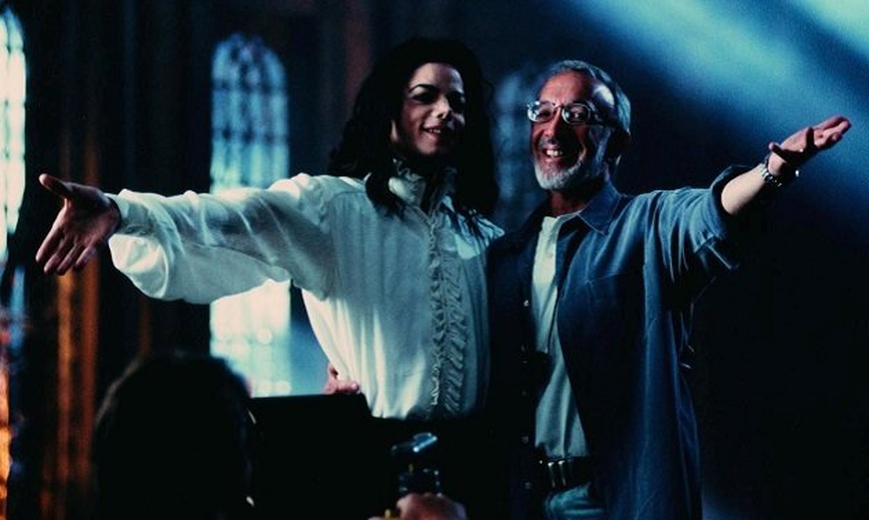
The Making of Michael Jackson’s Ghosts
In 1996, with the campaign to promote his HIStory album in full swing, Michael Jackson set out to make a music video that he and horror novelist, Stephen King had dreamt up several years earlier, in 1993. Looking to follow up on the success of his 1983 masterpiece, 'Thriller,' masterfully directed by John Landis, Michael originally planned a short music video for the song, 'Is It Scary,' which was originally written, but not used, for the 1993 film Addams Family Values. When Michael expanded the track and the concept, the project became for a time, the longest music video ever created, a short feature clocking in a 39 minutes and 32 seconds and renamed, "Michael Jackson’s 'Ghosts'."
Jump To Section
- Stan Winston as Director for Ghosts
- Behind the Scenes of MJ’s Ghosts
- Creating Michael Jackson’s Stretching Face Effect
- Makeup Effects for the Ghouls
- Designing the Ghost Family
Watch the four-minute video version of 'Ghosts' here:
Stan Winston as Director for Ghosts
Originally the writer/director Mick Garris (Stephen King's "The Stand," Hocus Pocus, Critters 2) was slated to write and direct the short film, but in 1996 when Michael Jackson was finally ready to green-light 'Ghosts,' Garris was committed to another project, a three-part mini-series based on King's The Shining. Garris recommended effects wizard Stan Winston (Pumpkinhead), to take over the reins. Michael Jackson called Stan personally to ask if he might consider directing the film. Stan agreed with only one condition: that Michael would play all the lead roles.
“I wanted Michael to play the haunted house guy," said Winston, "but also the mayor of the town, and an evil demon who comes in at one point. Michael wanted badly to be accepted as an actor, as something more than the King of Pop. But it was so difficult for people to get past Michael’s persona, I thought that the only way he would be accepted as a real actor was if he played all these parts, disguised in makeup, so that no one would know it was him until the end. And he was very agreeable to that idea.”
 (Michael Jackson with his Ghost family on the set. Stan Winston worked closely with cinematographer Russell Carpenter to make 'Ghosts' a spectacle of light and magical effects.)
Michael played all five of the main characters including, The Mayor, The Maestro, The Skeleton, The Super Ghoul, and The Ghoul Mayor. Filming took place over six-weeks of intense production. Although 'Ghosts' was originally supposed to be 12–15 minutes long, the final running time of nearly 40 minutes landed the film in the 2002 Guinness Book of World Records as the longest music video in history, a record that held till 2013 when Pharrell Williams released his 24-hour music video for 'Happy.'
Behind the Scenes of MJ’s Ghosts
As director, Stan Winston chose to implement many and varied special effects. Winston included a number of never-before-seen visual effects which were created by the newly formed computer graphics division of Stan Winston Studio, Stan Winston Digital. This division would soon become the start of the company Digital Domain--through a partnership between Winston, James Cameron and ILM's Scott Ross.
 (Michael Jackson in makeup as The Mayor, stands next to Stan Winston.)
The film tells the story of a strange and mysterious Maestro who is set upon by some angry locals who persecute him for being different and weird. Winston's most significant script change to Mick Garris's original script, saw the introduction of The Mayor, who leads the townspeople against the Maestro. The confrontation occurs in the Maestro's mansion, where the Maestro conjures up a dancing ghost family, including a CGI skeleton that dances as only Michael Jackson can dance.
 (The makeup process for The Mayor. Foam rubber prosthetics were applied, transforming MJ into a 50-year old white man.)
 (MJ in the Mayor makeup. The foam pieces were given a preliminary coloration, then hand-painted after application.)
Creating Michael Jackson’s Stretching Face Effect
Michael Jackson's transformations included a scene where The Maestro stretches the skin of his face. Paul Mejias did a clay casting of Michael's head from a life-cast impression. This sculpture served two purposes: first it was used to cast the skin that Michael pulls off, revealing the skull underneath; secondly, the casting served as a form to sculpt Michael's skull as the Skeleton.
 (Concept art for MJ's stretching face by Miles Teves.)
Paul Mejias's skull was used as the digital reference model for Michael's skeleton dance. In one of the first instances of early motion-capture techniques, by putting markers on Michael's body, his captured performance was able to drive the movements of the digital character that later transforms into the Super Ghoul.
 (On the left: Paul Mejias sculpts the skull made to fit inside a silicone casting of Michael Jackson's skin. On the right: Very fragile wax castings of the skulls made to break apart easily when struck.)
Makeup Effects for the Ghouls
Later in the video, Michael appears as the Super Ghoul and enters the Mayor's body to transform him to Mayor Ghoul. The film ends with the Maestro scaring the Mayor from the mansion as he wins over the people of the town.
 (Michael Jackson in the Super Ghoul makeup.)
 (Stan Winston and MJ, in ghoulish makeup, review a take on the video monitor.)
 (Based on Mike Smithson's sketches, a team of Stan Winston artists sculpted the Mayor expressions heads.)
 (Michael Jackson unrecognizable as the evil Mayor Ghoul.)
Designing the Ghost Family
SWSCA artist/instructor, Bruce Spaulding Fuller designed the ghastly dancers' makeup. Each dancer has a distinct personality, and every dancer has specific and individual characteristics to its makeup and costuming.
 (One of the dancers in the final makeup and costume.)
 (Female dancer in the final makeup and costume.)
 (Another ghostly dancer in the final makeup and costume.)
In the video, ghostly dancers appear at first in ectoplasm form; then they take on solid form. These corporeal ghosts walk and jump on the walls, twirl on columns, and dance on ceilings. The effects were achieved by using a combination of digital compositing, some CGI enhancement, and many in-camera tricks.
 (Ursula Ward touches up the hair piece on a ghastly puppet for a greenscreen shot.)
Parallels between the film’s storyline and the rumors then circulating about Michael Jackson’s private life led to 'Ghosts' getting only a very limited release. Michael Jackson's 'Ghosts' premiered at the end of 1996 and was released along with Stephen King’s horror movie, Thinner. 'Ghosts' was screened at the 1997 Cannes Film Festival, and it won the Bob Fosse Award for “Best Choreography in a Music Video.”
There were accusations about MJ's inappropriate behavior with young children--charges more serious than just being "different" or "weird." These charges would follow Jackson for the next twelve years until his untimely death at age 50 from a drug overdose. But, Stan Winston, interviewed at the time, said, “I’m still proud of the way 'Ghosts' turned out, though. And I really enjoyed making the film with Michael. He was a complete professional throughout the process — the consummate performer.”
 (MJ, in makeup disguise, sits beside Stan Winston and the cast of ghost dancers on the set of 'Ghosts.')
'Ghosts' was Stan Winston's last project as a director. He went on to take a more active role in film production as a producer. As he put it, “Producing allows me to develop projects, to be part of the creative process of making movies, but in a way that isn’t all-consuming. I call producing, ‘directing - without the responsibility.’ And I like it that way.”
- Blog assembled by Balázs Földesi with selections from The Winston Effect: The Art and History of Stan Winston Studio by Jody Duncan
Courses with the Creators of Ghosts
- How To Sculpt A Character Makeup with Bruce Spaulding Fuller
- How To Make A Zombie Horde On A Budget with Bruce Spaulding Fuller
- Character Prosthetics - Casting Flexacryl Fingers And Silicone Ears with Bruce Spaulding Fuller
- How To Make An Eye Mechanism - Design, 3D Printing & Assembly with David Covarrubias
- Animatronic Control Systems - Arduino Programming Basics Part 1 with David Covarrubias
- Making a Stone Mold with Gary Yee
- Portrait Illustration Part 1: Pencil Drawing Techniques with Terry Wolfinger
- Portrait Illustration Part 2: Painting With Photoshop with Terry Wolfinger
Check Out These Pathways to Create Your Own Character
- RECOMMENDED FOR DESIGNERS: Design Basics
- RECOMMENDED FOR ALL MONSTER MAKERS: Eye & Teeth Basics
- RECOMMENDED FOR FABRICATORS: Fabrication Basics
- RECOMMENDED FOR FILMMAKERS: Filmmaking
- RECOMMENDED FOR HAIR MAKERS: Hair Work
- RECOMMENDED FOR MAKEUP ARTISTS: Makeup Effects Basics
- RECOMMENDED FOR MECHANICS: Mechanical & Animatronic FX Basics
- RECOMMENDED FOR MODEL MAKERS: Model Making
- RECOMMENDED FOR MOLD MAKERS: Molding & Casting Basics
- RECOMMENDED FOR PAINTERS: Painting Basics
- RECOMMENDED FOR PUPPET MAKERS: Puppet Making Basics
- RECOMMENDED FOR SCULPTORS: Sculpture Basics