
The Making of the Zathura Robot
Based on a children’s book by Chris Van Allsburg, Zathura: A Space Adventure is about two boys who, one boring afternoon, begin to play an old board game found in the basement. Suddenly, the children find themselves — and their house — launched into outer space, suffering attacks from menacing robots and aliens.
Stan Winston Studio was contracted to create those robots and aliens, which — due to Director Jon Favreau’s love of in-camera, old-style filmmaking techniques — would be realized primarily as full-scale puppets and performers in suits. “Favreau came to us,” recalled Shane Mahan, “and said: ‘Look, I’m a fan of effects movies, but I don’t like the way digital stuff looks. It always looks artificial to me, and it takes me out of the film, no matter how good it is. So I want to make this film as much in-camera and real as I can.’ That was such a refreshing thing to hear."
Jump To Section
- Combining Practical and Digital Techniques
- Designing a Retro Robot
- Using Practical Effects in a Digital Era
 (Zathura director Jon Favreau inspects the milled-foam robot.)
Combining Practical and Digital Techniques
The robot was actually a hybrid of live and digital effects, an approach the studio was just beginning to explore in a serious way.
 (Concept sketches from Zathura by Eric Ramsey and Phil Saunders.)
“We wound up doing some interesting combinations of live-action and computer-generated imagery [CGI] for this show,” said Mahan. “For example, the robot was a guy wearing a robot suit — but with bluescreen legs, so they could give him very thin, mechanical CGI legs. It gave the actors a real character to interact with, and it gave Favreau something real to direct, but the final character wouldn’t look like a guy in a suit.”

 (Hybrid effects in action; while the top half of the robot was achieved with a practical costume, the performer's legs were digitally replaced, and robot arms were digitally added for the final shot.)
Designing a Retro Robot
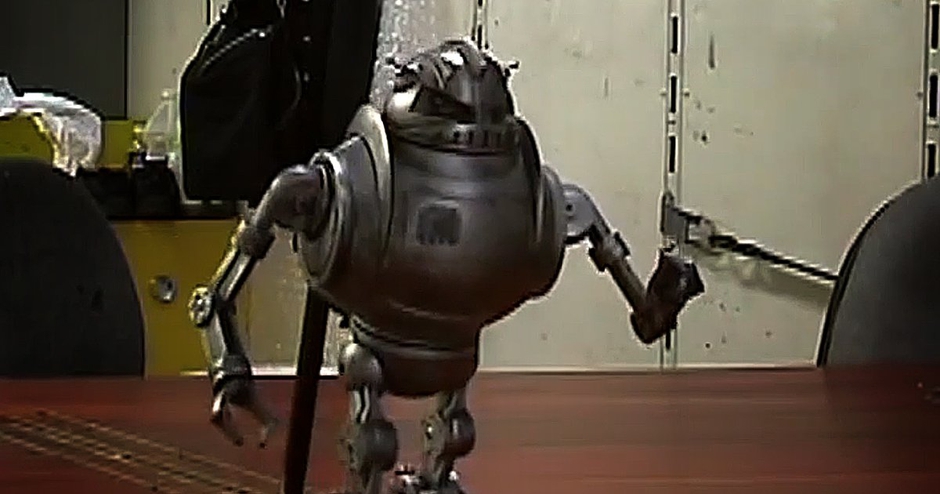
The giant robot that menaces the boys first appears as a ten-inch-tall toy, which the Winston crew built as a rod puppet, puppeteered from beneath the floor of the house interior set. Winston Studio designed the toy and its full-size counterpart as a kind of 1950s space-movie robot, fitting the movie’s overall retro style.
 (When we first see the Robot in the movie, it's a 10-inch tall toy brought to life with a rod puppet.)
“That robot was a chance for us to parody ourselves a little bit,” said Mahan. “We’d done all these scary, complex robots — and here was this big goofy 1950’s version.” “Shane and I loved the look of that robot,” added Matt Heimlich, who led the mechanical effort for Zathura. “It was everything we’d grown up on, the kind of thing that had excited us about this industry when we were kids."
 (Shane Mahan puts the finishing touches on the robot's torso and pelvis before it goes to paint.)
The studio built the full-size robot in several configurations. One was a non-articulated metal prop used in shots of its smashing through doors and walls. One was a full-body puppet, and the third — featured most prominently — was the performance robot suit worn by an actor. “The performance robot was not a full robot,” said Heimlich, “just pieces that a performer in a black leotard wore. He performed the actions on the set, wearing the robot pieces; and then, they shot clean plates with motion control, and Sony Pictures Imageworks, the digital company, painted out all the leotard parts and put in digital imagery, connecting the practical pieces to create the full-body robot.”
 (Hello Robot! The finished look of the Robot from Zathura.)
Using Practical Effects in a Digital Era
After a decade of dealing with directors besotted with computer technology, Winston and his crew saw Zathura as the beginning of a backlash against all-digital characters — and the trend has continued as new, young filmmakers seek the advantages of having real and tangible characters on their sets.
 (An artist makes an adjustment to the claw arm for the Zathura robot, though the arms in some shots would be added digitally.)
“These new directors really want to use practical creature effects. [They] have grown up in the digital era,” Chris Swift remarked, “and they aren’t that familiar with the more traditional, practical way of doing things. So, when they come to the shop and see it in person, they get very excited about it. They say, ‘You mean I could have that on my set?’ We’re cool again.”
-Jody Duncan
Excerpted from THE WINSTON EFFECT: THE ART AND HISTORY OF STAN WINSTON STUDIO
Courses with the Creators of Zathura: A Space Adventure
- Special Effects Sequence Design with Shane Mahan
- Hybrid Character Design: Practical To Digital with Christopher Swift
- Maquette Painting Techniques with Trevor L. Hensley
- Creature Costume Basics with Dawn Dininger & Amy Whetsel
- Lab Work For Animatronic Characters Part 1: Making A Mechanical Core with Cory Czekaj
- Character Makeup - How To Run Foam Prosthetic Appliances with Cory Czekaj
- Character Makeup - How To Run Silicone Prosthetic Appliances with Cory Czekaj
- How To Make A Stone Mold with Gary Yee
MORE ROBOT STUFF FROM STAN WINSTON SCHOOL
- Giant Robot Mech Befriends Little Girl @ Comic-Con
- Giant Robot Mech Meets Stan Lee
- Giant Robot Mech Walking Test
- How to Make a Giant Robot Mech (1/7) - Trailer
- How to Make a Giant Robot Mech (2/7) - Concept & Design
- How to Make a Giant Robot Mech (3/7) - Prototyping
- How to Make a Giant Robot Mech (4/7) - The Art
- How to Make a Giant Robot Mech (5/7) - The Tech
- How to Make a Giant Robot Mech (6/7) - Comic-Con Debut