

The Influence of the FPS Video Game Doom (1993)
Not even 25 years ago, playing an "action" computer game meant you could move icons on screen with your joystick. Then, in 1992, id Software released a First Person Shooter (FPS) game called Wolfenstein 3D, and that changed everything. With gun and projectile weapon-based combat shown through the first-person perspective, you no longer played the character, now you were the character. One of the most influential games in this FPS genre was also an id Software release called Doom. You, as the player, have to battle the forces of Hell, both demons and the undead. Doom changed the way the industry looked at gaming. Since its debut, the Doom universe has expanded to a branded gaming franchise, including Doom II: Hell on Earth (1995), Final Doom (1996), Doom 3 (2004), and the latest Doom 4 (2016), and the original game has spawned numerous imitations, spin-offs, expansion packs and even, in 2005, a full-length dramatic feature film directed by Andrzej Bartkowiak.
Jump To Section
- Making Doom (2005), a First-Person Shooter Movie
- Creating the Baron of Hell
- Building Doom’s Imps
- The Rock’s Transformation From Sarge to Mutant
- Behind the First-Person Shooter Sequence in Doom
Making Doom (2005), a First-Person Shooter Movie
Based on the world of the Doom 3 computer game, the motion picture Doom tells the story of a group of marines sent to investigate trouble at a science station on Mars. While there, they encounter monsters known as imps, the result of certain bio-engineering experiments. The filmmakers knew they had to deliver photographically convincing imps and other demons, so they turned to a specialist, top character creator and four-time Oscar winner Stan Winston and his team at Stan Winston Studio.
 (Baron Demon for DOOM by Stan Winston Studio.)
Director Andrzej Bartkowiak wanted to keep computer-generated visual effects to a minimum and capture most of the action in-camera. Therefore, he relied on make-up effects and suit performers to achieve most of the film's creatures. Creature suits were designed and fabricated by Stan Winston Studio under the supervision of John Rosengrant. “I had never played the Doom computer game,” said John Rosengrant, “because I’m just not a computer game kind of guy. But I liked being called upon to do a good, old-fashioned monster movie again, which is what Doom really was. The creatures were going to be a mix of digital and practical, but they definitely wanted to shoot as much practical as they could, then augment certain shots with CG if they had to.”
 (Concept artworks by Aaron Sims showing the first stage of the infection.)
Doom features three different categories of monsters: the Baron (aka Hell Knight), imps, and more than 20 other demons. Some characters are entirely CGI, some are a combination of practical and CGI, and some are entirely practical as suits or achieved via makeup effects. Many different prototypes for each category of non-human character were created by concept artist Aaron Sims.
 (Aaron Sims design for Dr. Carmack (aka Carmack imp), final stage.)
Once a 2D design was approved, the SWS team would take life-casts from the performers, then sculpt, mold, and fabricate prosthetics, which would then be custom painted and finished before being applied on set. SWS crew did several test fittings with certain suit performers for critical roles, but due to the short preparation time, the final work often had to be completed in the Czech Republic, in Prague, where Doom's production was based.
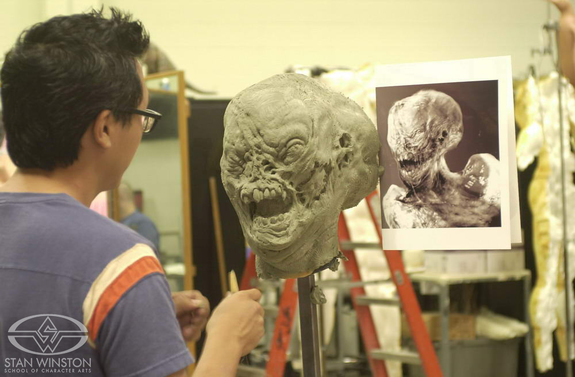 (Based on Aaron Sims' design, Eddie Yang sculpts the Carmack imp head.)
 (Pictured above: Rob Ramsdell and John Cherevka detail the grotesque forms of the Carmak imp monster suit.)
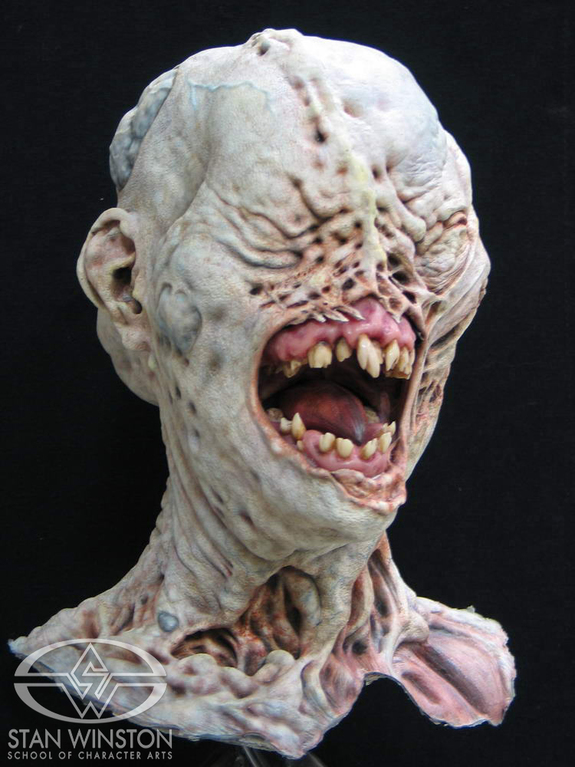 (The finished Carmack imp head.)
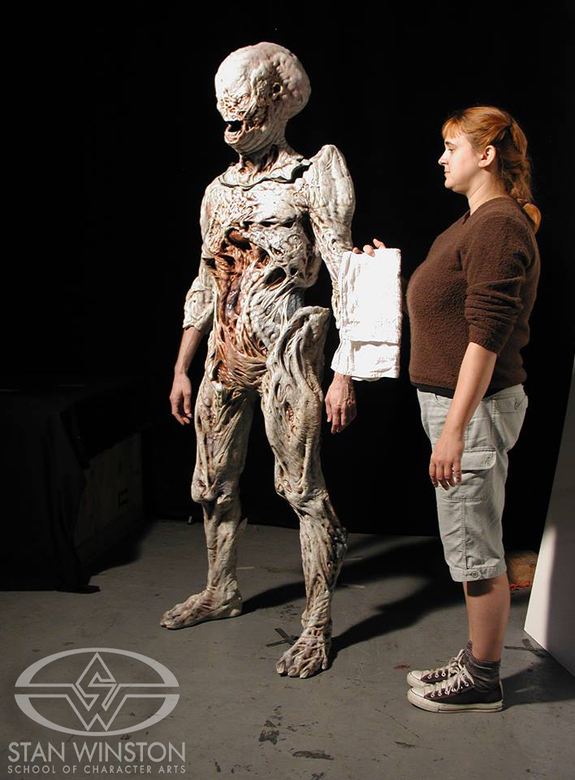 (Doug Jones in Carmack imp suit next to Kristen Willet at one of the suit tests.)
Creating the Baron of Hell
Creature performer Brian Steele (aka CreatureBoy) shouldered the Baron outfit. SWS crew wanted to keep the whole Baron suit very mobile with strong and organic movement. Although there were lots of muscles on the suit, it was lightweight so that when he moved, there was articulation, it didn't just move like a big, thick foam jacket.
 (More of Aaron Sims’ final concept art.)
 (Joey Orosco details the Baron sculpt, while Stan Winston offers his final critique.)
The structure underneath responded to Brian's movements and gave him the freedom and mobility necessary to express the character through choreography and performance.
 (A test fitting of the Baron character on suit performer Brian Steele.)
Different heads were made for the character, and each head served a different purpose. One head was treated and prepared so it could be lit on fire; another head was sculpted with an after-burned look complete with burnt and peeling skin. One of the heads had a jaw-and-lip mechanism on it, allowing for closeups of the mandible. A last "hero" head that had a little bit of everything, including servo-controlled mechanisms, eyebrows that could be very expressive, and a squinting motion around the eyes. Even the lips peeled back, providing a chilling smile. Though there were plans in place to augment the head with a CGI version in post, the animatronic head ended up working so well that no digital replacement was necessary.

Building Doom’s Imps
Veteran creature character performer Doug Jones played the Carmak imp as well as three other demonic imps in the film. All the demonic imp heads were constructed of foam latex, silicone rubber, and acrylic over a fiberglass substructure. Rob Ramsdell sculpted the imps, which were created as suits. “These characters were very weird and contorted,” said Rob Ramsdell, “almost as if their insides had been turned out. We were trying to make something with elongated forms, and I remember struggling with that when I was doing the sculpture. I asked Stan Winston for some help because he has a real talent for seeing things you may not see when you are working on something. He gave me some suggestions, and I executed them right on the spot, to make sure I understood exactly what he was talking about. We always do that when Stan is suggesting ideas for a sculpt. We’ll take some hot clay and just slap it on and rough it in right then and there while he is watching.” Each individual imp had its own distinct head with an individualized paint job.
 (The Sewer imp, sculpted over a life cast of Doug Jones by FX artists Jason Matthews, Eddie Yang, and Rob Ramsdell.)
Some creatures had no eyes, while others had a disturbing overabundance of eyes. The Sewer imp had eleven eyes altogether, creating a truly loathsome countenance.
 (The Carmack imp puppet used for autopsy scenes.)
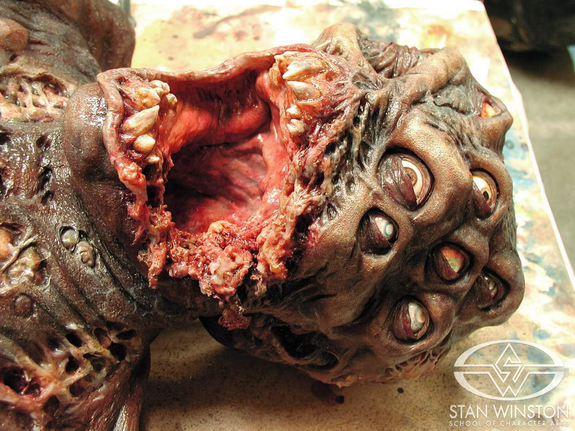 (Close shot of the Carmack imp puppet.)
The Rock’s Transformation From Sarge to Mutant
Dwayne The Rock Johnson plays Sarge, the leader of the mercenary team on Mars. In the last fight scene, his character gets infected and rapidly progresses through three stages of infection. We see the first stage when Sarge's knuckles burst out from his hand. Then the second and third stages each contort and transform his face in different ways.
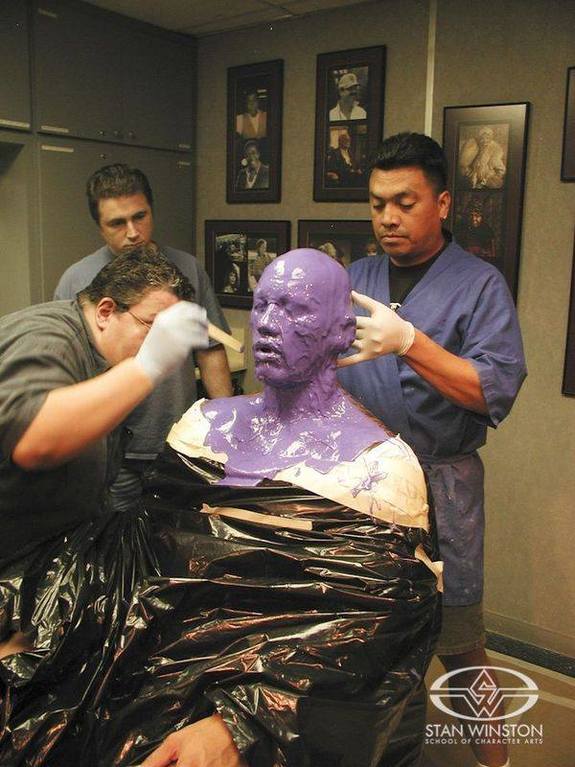 (The Rock undergoes a life cast from the Stan Winston Studios effects team.)
Behind the First-Person Shooter Sequence in Doom
The favorite sequence for hardcore gamers and fans who knew the characters from the video game was the FPS scene. Shot as a tribute to the gameplay, almost entirely in first-person point-of-view, this five-and-a-half minute continuous fight comprised an intense 2-week shooting plan incorporating a complex combination of live-action shooting, real sets, completely CG generated environments, practical creatures, and makeup creatures with CG heads and arms.
Watch behind the scenes of the FPS unit by Universal Studios with Oscar-nominated Visual Effects Supervisor and director of the FPS sequence, John Farhat, HERE:
- Blog assembled by Balázs Földesi with selections from The Winston Effect: The Art and History of Stan Winston Studio by Jody Duncan
Courses with the Creators of Doom
- Metallic Painting Techniques - Robot Finishes with Rob Ramsdell
- Hybrid Characters: Blending Practical & Digital FX with John Rosengrant
- How To Make Eyes: Puppets, Masks & Makeups with John Cherevka
- Making Creature Eyes with John Cherevka
- Animatronics Design Basics with Richard Landon
- Cable Mechanism Basics - Tentacles with Richard Landon
- How To Make A Stone Mold with Gary Yee
- Production Design: The Process Of Creating A World For Film with Jabbar Raisani and Eddie Yang