
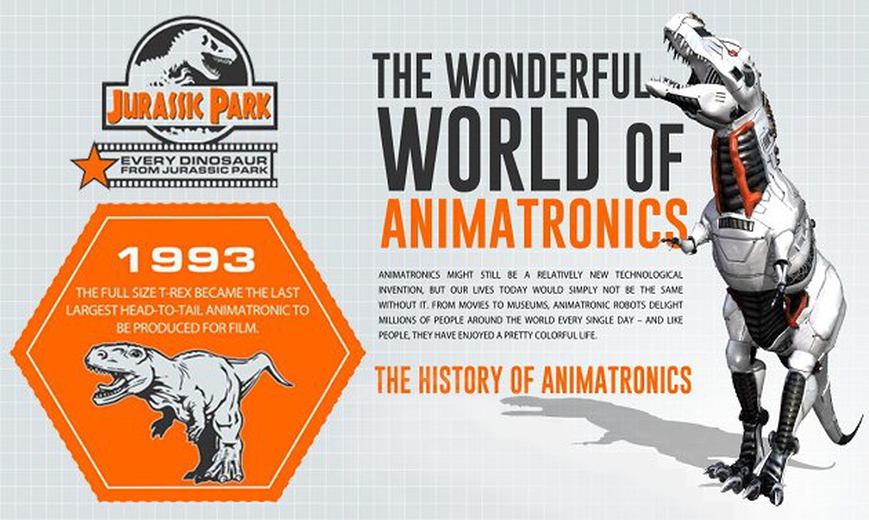
The Wonderful World of Animatronics
Although true animatronic characters didn't really exist till the late 20th century, the real history of the technique begins with 17th-century clockmakers. Advanced mechanical clocks dating back to pre-Industrial Revolution France featured miniature animated characters that would emerge from a time-keeping device when it struck the hour. Like modern animatronics, the movements of these automatons were programmed using mechanical gears to coincide with specific hours. Later, sounds were introduced to attract attention, and clockmakers used the characters to tell a story.
The modern era of animatronics began in 1961 when Walt Disney started developing animatronics for entertainment and film. Disney and his "Imagineers" created a 9-inch tall Dancing Man figurine. Though primitive by today's standards, the little man captured people's attention and got the animatronic ball rolling. Advances in robotics, programming, rapid prototyping, surfacing materials, and techniques make today's animatronic characters more lifelike than ever before. Movement and control of the animatronic figures can mimic natural life to an uncanny extent, tricking the eye. Thanks to animatronics, modern filmmakers can create creatures and characters that have physical presence and a palpable reality. And though advances in the digital arts allow today's filmmakers to depict astounding and impossible beings visually, there is still no comparison to having an animatronic. These characters exist in an unquestionable, substantial way. They can occupy the same space as the actors in a film and impact their environment more than any collection of pixels, however realistically rendered. They seem 'real' because they ARE real.
Jump To Section
The History of Animatronics
 (An infographic review of the History of animatronics from Disney to cinema by Custom Entertainment Solutions (CES) Inc.)
How to Get Started with Animatronics
Though the adaptability and variations possible with digital animation have somewhat curtailed the use of animatronics in recent years, certain studios and filmmakers are starting to champion the technique once again. Thanks to institutions such as The Stan Winston School of Character Arts, the once arcane processes that had to be invented by genius mechanics are now widely available to anyone with an internet connection. Through lessons and behind-the-scenes case studies, the next generation of filmmakers can gain insight and learn character creation, including design, life-casting, sculpting, mold-making, and painting. Students not just in Hollywood but worldwide can learn and appreciate the art and technology of animatronics/mechanics and electronics. And these tutorials don't stop at making machines. Every aspect of physical character creation is covered: model making, special effects makeup, fabrication, lab working, hair working, and filmmaking as well.
The artists/instructors at the SWSCA are the Renaissance artists of today. They are dedicated to teaching, promoting, and fostering innovation in the arts and sciences of character creation. Through their work and lessons, they keep the legacy of practical effects alive so that it may continue to enhance the entertainment experience for us all.