
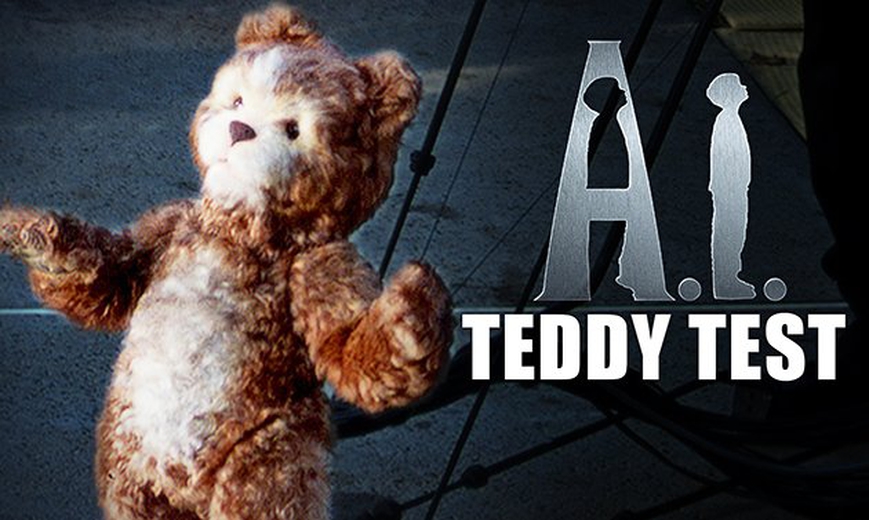
AI's Teddy, the Animatronic Supertoy Rehearsal
Stan Winston had more experience building robots than any other creature effects artist in the world — but the robots of AI would be unlike anything Winston, or anybody else, had ever created.
Although Winston and his crew were not afforded the chance to build the world’s first fully functioning animatronic boy for the film, AI did require them to create robots — dozens of them, in fact. These robots, called ‘mechas’ in the story, ranged from the utilitarian type — such as gardeners, security guards, and other blue-collar workers — to Gigolo Joe (Jude Law), a true ‘love machine’, and Teddy, a robotic teddy bear who serves as David’s sidekick.
Surprisingly, of all the robots designed for AI, the most difficult to conceptualize was Teddy, the ‘supertoy’ that would be a featured player in the film. “Designing Teddy was a huge job,” said Winston, who hired his largest crew ever to complete the robot construction project. At the height of production, Stan Winston Studio boasted 140 artists and technicians. Building Teddy, a more sophisticated and complex animatronic than any of the dinosaurs in Jurassic Park, required that increased manpower, plus the ingenuity and talent of many artists and technicians. “We’d given our Velociraptor thirty-four points of motion,” explained Winston, “and our T-rex, forty points of motion. But Teddy had fifty points of motion, all in a little character that was less than three feet tall. He had to act, he had to talk, and he had to deliver a varied and convincing performance. We had to create the ultimate robotic teddy bear — and that was the biggest, most difficult job we’d ever taken on.”
-Jody Duncan
Excerpted from The Winston Effect: The Art and History of Stan Winston Studio
Read the full AI behind-the-scenes story here: Steven Spielberg's A.I. Artificial Intelligence (2001) - Behind the Scenes at Stan Winston Studio
Courses with the Creators of AI: Artificial Intelligence
- Special Effects Sequence Design with Shane Mahan
- Hybrid Character Design: Practical To Digital with Christopher Swift
- Animatronics Design Basics with Richard Landon
- Cable Mechanism Basics - Tentacles with Richard Landon
- Robot Brains - Animatronic Character Servo Control with Rick Galinson
- How To Draw Monsters - Drawing Stan Winston Creatures with Tim Martin
- How To Sculpt With WED Clay with Tim Martin
- Styrofoam Prop Making with Tim Martin
- Making Creature Eyes with John Cherevka
- Advanced Creature Teeth: Prosthetic Dental Appliances with John Cherevka
- How To Lifecast: Head, Hands & Teeth with Mark Viniello
- Silicone Sculpting & Patching Part 1: How To Seam & Patch A Silicone Mask with Chris Grossnickle
- Silicone Sculpting & Patching Part 2: How To Patch A Prop Body with Chris Grossnickle
- Silicone Sculpting & Patching Part 3: How To Seam & Patch A Silicone Makeup with Chris Grossnickle
- Articulated Mask Making On A Budget 1: Lifecasting, Sculpting & Teeth with Patrick Magee
- Articulated Mask Making On A Budget 2: Fabricating Flesh, Painting & Hair Work with Patrick Magee
- Art of the Fat Suit with Dawn Dininger
- Creature Costume Basics with Dawn Dininger & Amy Whetsel
- Beauty & Age Makeup - From Script To Screen with Bill Corso
- Zombie Makeup - Appliances, Airbrushing, Lenses & Teeth with Bill Corso
- Out Of The Kit Makeup Effects with Joel Harlow
- Creature Makeup - Multi-Piece Silicone Prosthetic Application with Joel Harlow
- How To Make A Monster Puppet - Rods & Cables with David Monzingo
- Makeup Blood FX - Blow Your Brains Out with David Monzingo
- Introduction to Hair Knotting with Michael Ornelaz